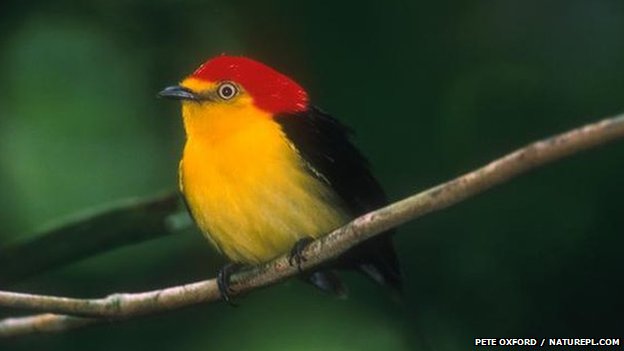
 The wire-tailed manakin faces an uncertain future
Up to 900 tropical bird species could 'go extinct'.
21% of Bird Species slated for extinction!
By Anna-Louise Taylor Reporter, BBC Nature News
The wire-tailed manakin faces an uncertain future
Up to 900 tropical bird species could 'go extinct'.
21% of Bird Species slated for extinction!
By Anna-Louise Taylor Reporter, BBC Nature News
The finding is modelled on the effects of a 3.5C
Earth surface temperature rise, a Biological Conservation Journal paper shows.
Species may struggle to adapt to habitat loss and extreme weather events, author Cagan Sekercioglu says.
Mountain, coastal, restricted-range, and species unable to get to higher elevations could be the worst affected.
Depending on future habitat loss, each degree of surface warming could affect between 100-500 species, says Mr Sekercioglu,
assistant professor of biology at the University of Utah.
"This gives us a clear big picture. The problem is most species in the world are highly sedentary... the public perception
is most birds are migratory and so climate change is not a problem for them," he says.
Mr Sekercioglu says tropical mountain species are among the most vulnerable. He says bird species will need to be able to
adapt physiologically to changes in temperature and be able to move to higher altitudes if they are to survive.
He says cooler, more humid forests could recede higher up mountains and combined with human settlements at higher altitudes,
forest habitat could "get pushed off the mountain".
This would create "an escalator to extinction" he says.
"Coastal species are also vulnerable - as coastal forest can be sensitive to salinity, and these forests can get hit harder by
hurricanes and typhoons, and these events are also expected to increase."
Birds in extensive lowland forests with few mountains in places such as the Amazon and Congo basins - may have trouble
relocating, while tropical birds in open habitats such as savanna, grasslands, scrub and desert face shrinking habitats.
Tropical birds in arid zones are assumed to be resilient to hot, dry conditions, but they could suffer if water sources dry
out.
Mike Crosby, senior conservation officer in Asia at Birdlife International says: "We know that quite a lot of tropical birds
are not very good at dispersing so this could be a big issue in the future if the suitable climate moves several hundred
kilometres or even tens of kilometres, some of the birds might not be able to move their ranges sufficiently quickly in
response to that.
"We might have to take novel conservation measures in the future such as translocation of birds from one site to another."
The study looked at how manakins, of which there are 45 species in the neotropical region, would cope. Results showed that
manakins limited to the lowland habitats of the Amazon and Cerrado in Brazil, would be most affected as they could lose up
to 80% of their habitat; as many as 20% of the Cerrado manakin species are expected to go extinct.
Cagan Sekercioglu says: "Manakins show the importance of having a wide tropical area of mid-elevation forests, and being able
to move to higher elevation forests."
He says while overall "birds are one of the least threatened groups of animals" by climate change, "they are the 'best case'
scenario".
"The findings are likely to be much worse for all other groups of animals," he says.
"We need to be planning protected areas with higher elevations in mind and leave breathing room for endangered species in
higher elevation areas," says Mr Sekercioglu.
Mr Crosby says: "We've got to prepare ourselves to be measuring temperature in protected areas, and measuring rainfall, and
monitoring what's happening to species, so that we can respond in the appropriate way. It's very difficult to predict very
precisely what's going to happen."
He adds that visitors to the region could help protect the birds they travel to see.
"People who go bird watching in the tropics can gather very useful data, given that the current data that we have is basically
pretty poor in many parts of the world. Amateur bird watchers can really make an important contribution."
Source: http://www.bbc.co.uk/nature/17212765
Fifth of British birds vanish in just 50 years:
Habitat loss blamed for rapid decline of common species
By Nick Mcdermott
PUBLISHED:00:01 GMT, 19 November 2012
Sparrows, starlings and other common birds are rapidly disappearing – with numbers plummeting by more than a fifth in recent
decades.
Some 44million breeding birds have been lost from Britain since 1966, and many species are facing a bleak future.
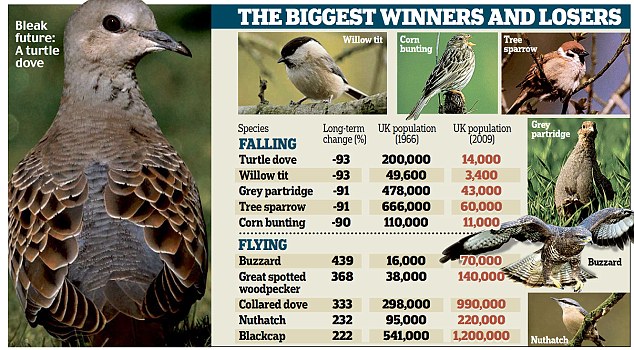
While two turtle doves may represent a true love’s gift in the 12 Days of Christmas carol, birdwatchers could soon struggle
to see even one on our shores as the population has plunged by more than 90 per cent.
The decline is thought to be due to a lack of seed and grain which is essential fodder during the breeding season, according
to the Royal Society for the Protection of Birds.
Illegal hunting in the Mediterranean as the birds fly over on their annual migration and changes to their African wintering
grounds may also be factors.
The house sparrow has also seen a significant decline, down by two-thirds in less than 50 years to leave an estimated
population of ten million.
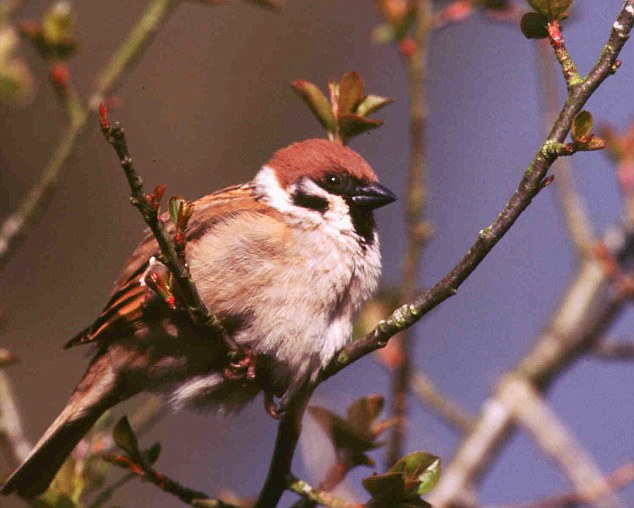
And its smaller cousin, the tree sparrow, has been even more seriously affected, with a staggering 91 per cent drop in its
numbers to leave just 60,000 in the UK. Similar falls have hit the willow tit and the grey partridge.
The annual State of the UK’s Birds report estimates there are 166million nesting birds in Britain, down from 210million in
1966.
It is the first time the RSPB has charted the overall decline in bird numbers across all species.
Dr Mark Eaton, an RSPB scientist, said: ‘It is shocking to think that we’ve lost one in five of the individual birds that we
had in the 1960s, especially when you think that the 44million birds we have lost since 1966 is equivalent to the current
adult human population of England and Wales.’
Habitat loss is the key reason behind the dramatic decline in many species, while cold winters, which can kill many birds
through starvation, have also played a role.
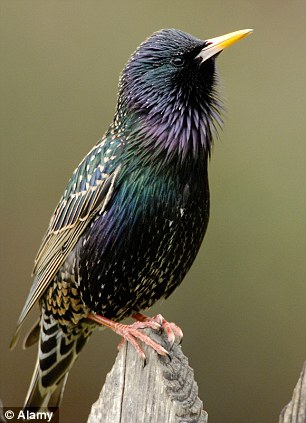
Starlings, known for their glossy green-purple plume and noisy song, are among those badly affected, with a drop of almost 80
per cent in their numbers.
The total population stands at almost two million, a sharp fall from the ten million that took to the skies in the 1960s.
In the first RSPB Big Garden Birdwatch survey in 1979, the average number of starlings seen in each garden was 15. This year,
it was three.
Experts believe the decline could be due to changes in soil which affect the insects they eat and force them to look elsewhere
for food.
Meanwhile, the wren – still the UK’s most numerous bird – has lost an average of 835 a day since 2000.
But it’s not all bad news, and another garden bird, the chaffinch, has increased at a rate of 150 per day. There has been a
439 per cent rise in the population of buzzards, while the numbers of great spotted woodpeckers have more than trebled.
Richard Hearn, head of species monitoring at the Wildfowl and Wetlands Trust, warned international action is still needed to
protect bird numbers.
He said: ‘Sea duck numbers in Europe have crashed and they urgently need conservation. Velvet scoter overwintering in the UK
have gone from several thousand birds to fewer than a hundred in just a few years, and the picture for long-tailed duck is
similar.
‘Several other species have also shown large declines. We’re getting a clearer understanding of the problem, but to be
effective we need all countries to work more closely together.’
Dr Andy Musgrove, from the British Trust for Ornithology, said: ‘Amongst individual species, whilst there have been some
winners, the number of losers is greater and the long-term picture is sobering.’
Read more: http://www.dailymail.co.uk/news/article-2234915/Fifth-British-birds-vanish-just-50-years-Habitat-loss-blamed-rapid-decline-common-species.html#ixzz2CddQzc51